Commercial-Grade Multi-Layer Stainless Steel Cookware Engineered for Global Brand Distribution
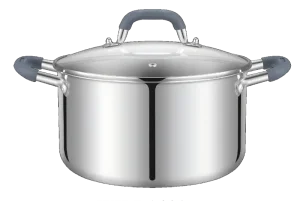
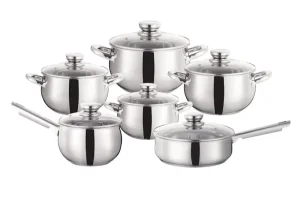
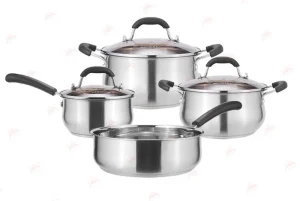
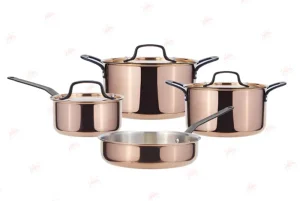
Analyzing Micro-Surface Roughness, Mechanical Abrasion, and Thermal Dynamics for Professional Culinary Engineering
When global commercial cookware buyers evaluate China satin interior cookware companies & company options, the distinction between surface finishing methodologies represents far more than an aesthetic choice. A satin interior finish—frequently referred to in metallurgical standards as a brushed, directional grain, or matte mechanical finish—is an engineered surface topography designed to resolve fundamental friction, thermal conductivity, and durability challenges inherent to modern culinary processing.
Unlike mirror-polished interiors that present a ultra-smooth microscopic profile ($R_a < 0.1\ \mu\text{m}$) or PTFE/ceramic non-stick coatings that rely on synthetic hydrophobic chemical membranes, a precision-machined satin interior relies on controlled micro-grooving. This micro-grooved surface profile ($R_a$ optimized between $0.4\ \mu\text{m}$ and $0.8\ \mu\text{m}$) creates microscopic valleys that retain cooking oils and natural lipids through capillary action, drastically enhancing physical non-stick release properties without risking coating degradation or chemical leaching under high temperatures.
Metallurgical Edge: Satin interiors eliminate the visual scarring caused by metal utensils and high-abrasion commercial dishwashing cycles. Furthermore, the micro-textured satin grain reduces surface tension, preventing liquid pooling and ensuring localized Maillard reaction consistency across the entire bottom inner radius of stockpots, casseroles, and saute pans.
| Surface Finish Profile | Micro-Roughness ($R_a$) | Utensil Scratch Visibility | Capillary Oil Retention | Chemical Longevity |
|---|---|---|---|---|
| Satin Interior (Engineered) | $0.4 - 0.8\ \mu\text{m}$ | Extremely Low (Concealed Grain) | High (Micro-Capillary Valleys) | Lifetime (100% Solid Alloy) |
| Mirror Polished Interior | $< 0.1\ \mu\text{m}$ | Very High (High Contrast) | Low (Immediate Bead Off) | Lifetime (Prone to Micro-Pitting) |
| PTFE Fluoropolymer Non-Stick | $0.2 - 0.5\ \mu\text{m}$ | Severe (Risk of Flaking) | Moderate | 1-3 Years (Degrades >260°C) |
| Sol-Gel Ceramic Coating | $0.3 - 0.6\ \mu\text{m}$ | High (Chipping Hazard) | Moderate | 1-2 Years (Thermal Shock Loss) |
27+ Years of Dedicated OEM/ODM Manufacturing Excellence in Stainless Steel Cookware
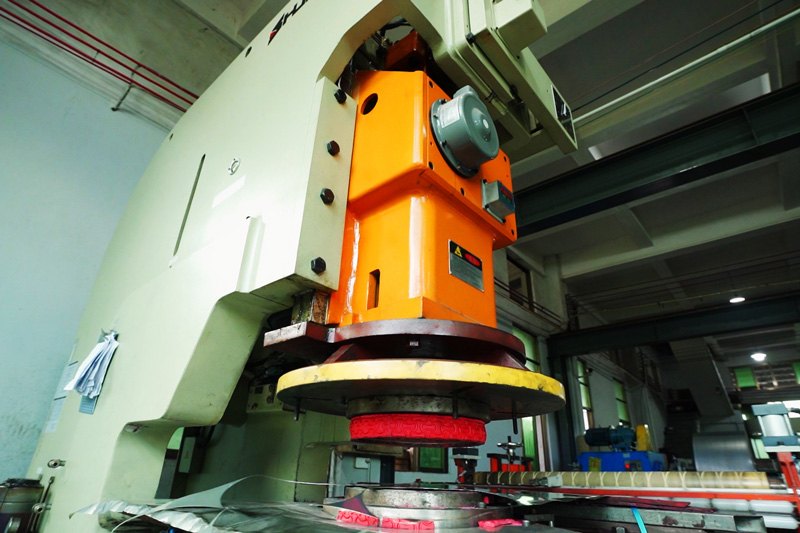
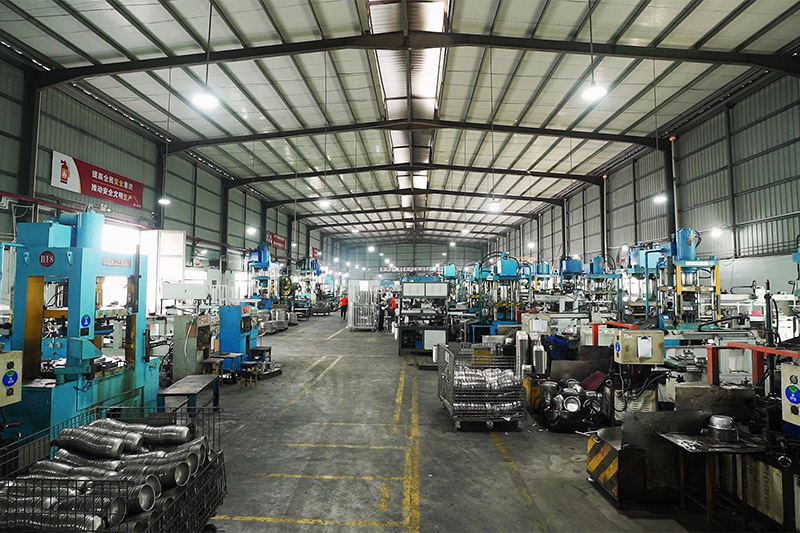
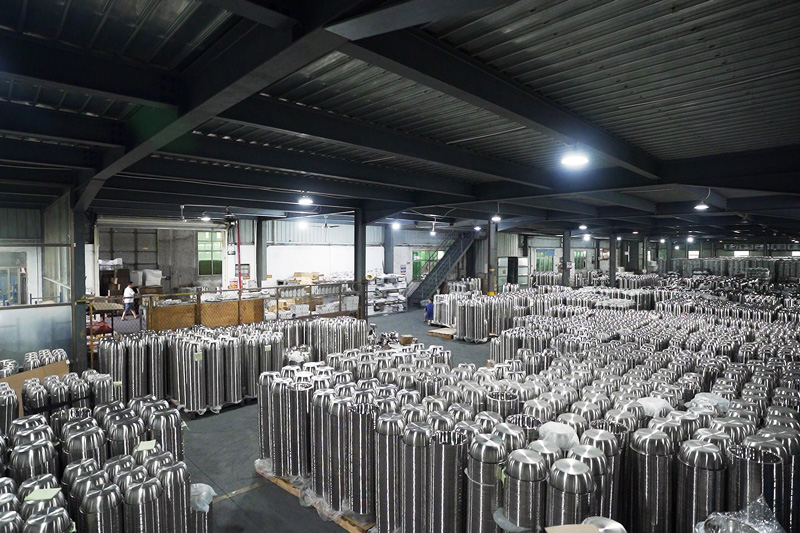
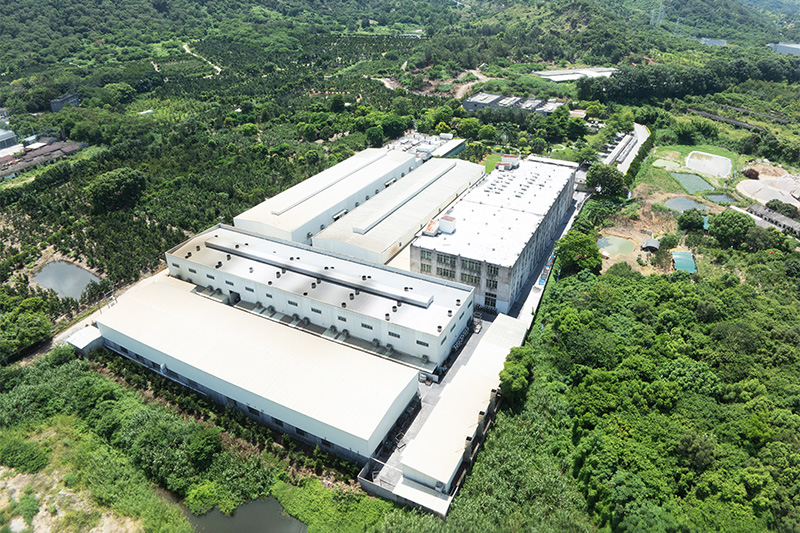
Established in 1997, Chaozhou Chaoan Weihua Hardware and Electrical Appliances Co., Ltd. is located in Chaozhou, a beautiful and prosperous industrial hub in South China. Operating from a massive factory footprint spanning over 350,000 square feet (30,000+ square meters), Weihua houses 35 automated production lines backed by a skilled workforce of over 300 experienced technical specialists and engineers.
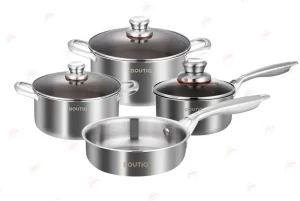
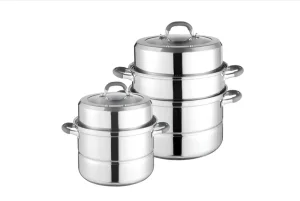
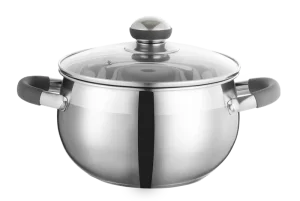
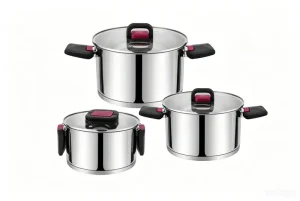
With an unwavering focus on precision stainless steel cookware (including stockpots, belly-shape cookware sets, steamer pots, frying pans, and commercial mixing bowls), Weihua has evolved into one of the paramount tier-1 China satin interior cookware companies. Our facility integrates automated metal spinning, hydraulic deep drawing, multi-layer clad impact bonding, and automated multi-stage interior satin brushing.

Engineering Control, Specialized Production, and Verified Long-Term Client Retention
We continuously transform emerging consumer preferences into technical innovations. Utilizing consumer-oriented ergonomics, our engineering team refines wall thickness, heat diffusers, and satin grain depth.
We focus exclusively on high-grade stainless steel cookware (casseroles, steamers, soup stockpots, fry pans) and prep bowls (salad bowls, colanders), guaranteeing unmatched process mastery.
Our facility enforces strict 6S management protocols (Seiri, Seiton, Seiso, Seiketsu, Shitsuke, Safety), significantly reducing raw material waste and guaranteeing zero-defect delivery batches.
Over 60% of our global client base has maintained continuous business partnerships with Weihua for over 10 years, reflecting unmatched trust across European and North American markets.
Ensuring Full Adherence to EU LFGB, US FDA, DGCCRF, and International Quality Standards
For international procurement managers sourcing from a China satin interior cookware company, market entry hinges upon flawless compliance with regional chemical safety regulations. Stainless steel alloys subjected to acidic food contacts (such as citric acid, tomato purees, or vinegars at boiling temperatures) can leach chromium, nickel, or manganese if raw material grade integrity or surface passivations are compromised.
Weihua implements strict X-ray Fluorescence (XRF) alloy verification at raw material intake (using premium SUS 304 / 18-8 food-grade steel) and subjects finished satin interior pots to electro-chemical citric acid passivation. This creates an impenetrable, auto-regenerating chromium oxide layer ($\text{Cr}_2\text{O}_3$), passing the most demanding migration tests under German LFGB and European Regulation (EC) No 1935/2004.
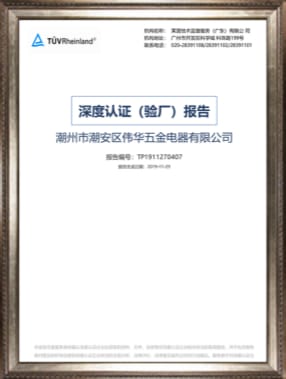
TUV Rheinland Tested
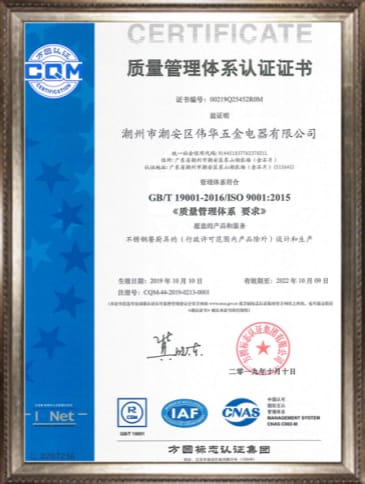
ISO-9001:2015 Quality Management
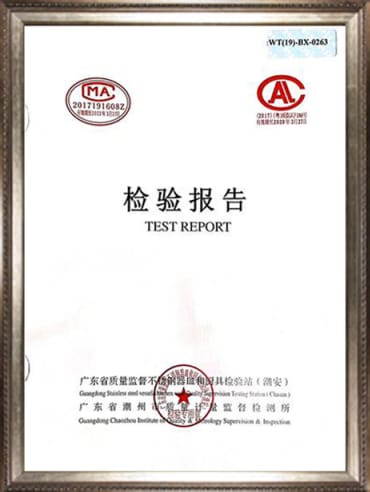
CMA China Accredited
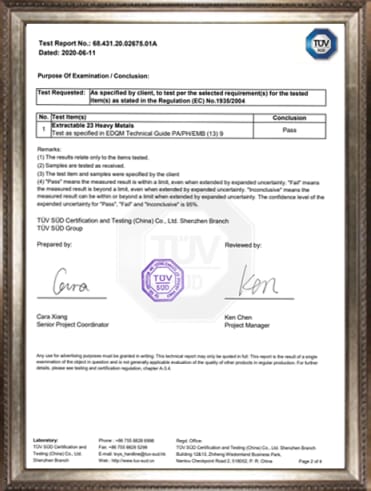
Germany LFGB Food Safe
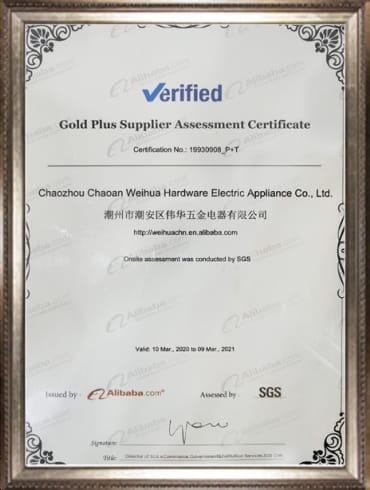
LFGB Chemical Migration
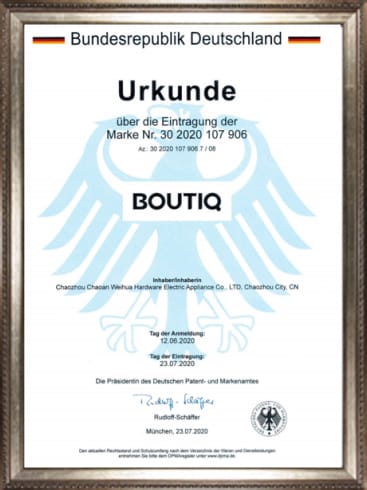
BOUTIQ Trademark
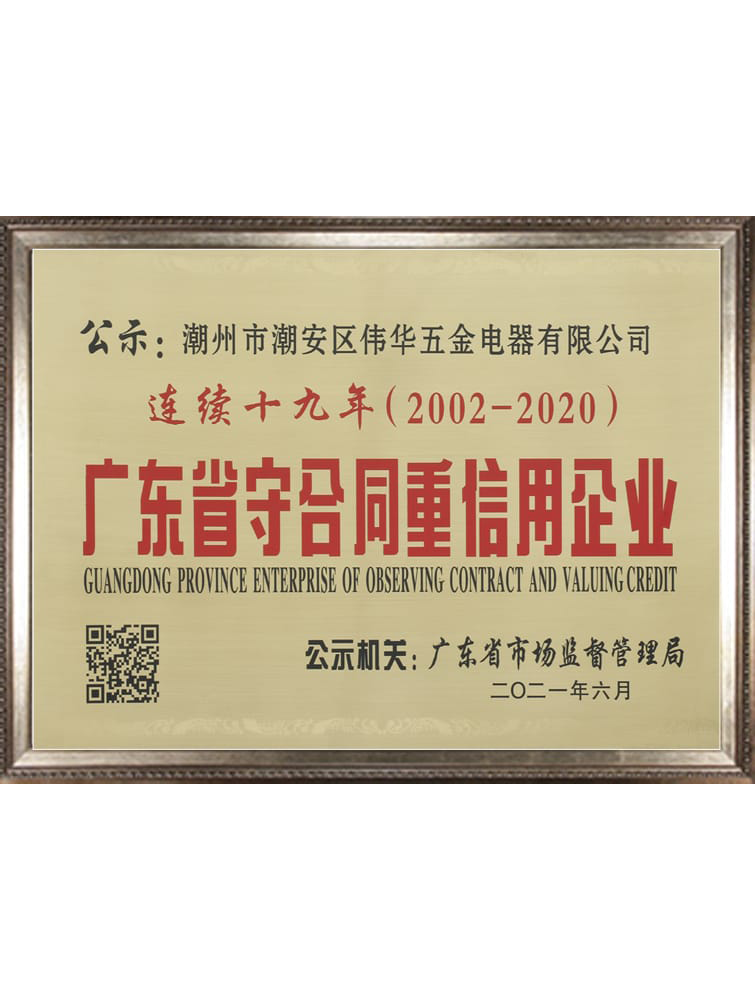
19-Yr Credit-Worthy Award
Leveraging Chaozhou's Raw Material Synergy & Advanced Multi-Layer Thermal Conductive Bimetals
The strategic concentration of stainless steel manufacturing in Chaozhou, Guangdong provides an extraordinary supply chain resilience for international buyers. Raw steel coil sourcing, custom die-tooling fabrication, bakelite and silicone handle molding, and automated packaging printing operate within a 15-kilometer manufacturing radius. This cluster advantage directly translates into shorter production lead times, superior quality consistency, and cost structure optimization.
Furthermore, our satin interior cookware utilizes advanced multi-layer thermal cladding structures. Stainless steel alone possesses relatively low thermal conductivity ($15\ \text{W/m}\cdot\text{K}$). To overcome hot-spot scorching, Weihua applies friction-screw impact bonding under 2,500 tons of hydraulic pressure, fusing a pure aluminum core ($237\ \text{W/m}\cdot\text{K}$) between the interior SUS 304 layer and an exterior magnetic SUS 430 stainless steel layer.
| Layer Component | Material Composition | Functional Role | Thermal / Physical Characteristic |
|---|---|---|---|
| Interior Layer | SUS 304 (18/8 Stainless Steel) | Food Contact & Satin Finish | Inert, Acid-Resistant, Satin Micro-Textured |
| Thermal Core | 1050/1100 Pure Aluminum | Heat Distribution Vector | Rapid Lateral Heat Transfer (No Hotspots) |
| Exterior Layer | SUS 430 (Ferritic Stainless) | Induction & Cooktop Interface | High Ferromagnetic Permeability |
Comprehensive OEM/ODM Service Architecture tailored for Importers, Distributors, and Brands
Choose from stay-cool hollow stainless steel handles, ergonomic soft-touch silicone grips, PVD rose-gold electroplated handles, or heat-resistant foldable Bakelite handles designed for compact storage.
Options include tempered glass lids with steam vents, flat stainless steel lids with silicone rims, and drip-free folded pour rims engineered to prevent accidental spillages during commercial service.
Custom laser-etched interior liquid measurement scales (in liters and quarts) seamlessly integrated within the satin grain, alongside deep laser base logos for elevated brand equity.
5-ply corrugated color boxes, ISTA-tested drop-safe e-commerce mail order packaging, drop-ship protective inserts, and eco-friendly plastic-free protective sleeves.
Key Trends Shaping Global Stainless Steel Cookware Manufacturing and Procurement Demand
As global environmental regulations tighten—exemplified by EU restrictions on PFAS "forever chemicals"—consumer preferences are rapidly pivoting away from synthetic non-stick coatings toward pure, non-toxic stainless steel solutions. Satin interior finishes represent the epicenter of this market migration.
Key technological and market shifts driving the next decade of cookware sourcing include:
Expert Answers for OEM Sourcing Managers, Importers, and Retail Brand Buyers
A satin interior finish features a deliberate, directional micro-brushed texture ($R_a\ 0.4-0.8\ \mu\text{m}$) that hides scratches caused by metal utensils and enhances oil retention for cooking. A mirror finish is polished to an ultra-smooth surface ($R_a < 0.1\ \mu\text{m}$), which shows scratches easily and tends to allow liquids to bead off quickly.
Yes. All Weihua stainless steel cookware products are manufactured using certified food-grade SUS 304 stainless steel for food contact surfaces. Our products undergo rigorous chemical leaching tests and carry certifications from TUV, ISO-9001:2015, CMA China, and German LFGB compliance passes.
Standard MOQ for custom OEM cookware sets typically starts at 1,000 to 2,000 sets depending on body shape and handle complexity. Production lead times range from 30 to 45 days after artwork and pre-production sample approval, supported by our 35 automated lines yielding up to 10,000 pots daily.
Absolutely. Weihua cookware features multi-layer impact-bonded bases or tri-ply clad structures incorporating magnetic SUS 430 stainless steel on the exterior bottom, making them 100% compatible with induction, gas, electric, ceramic, and halogen stovetops.
Satin interior finishes excel in commercial high-temperature dishwashing. Because the directional grain is mechanically ground into solid stainless steel, it does not chip, peel, or degrade when exposed to aggressive industrial detergents or heat cycles.
Explore More High-Efficiency Stainless Steel Cookware, Sauce Pans, and Kitchenware Sets
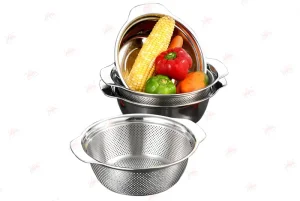
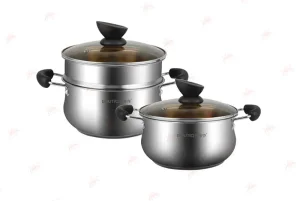
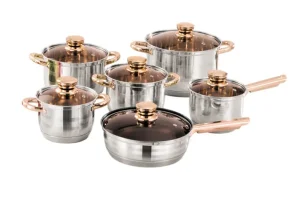
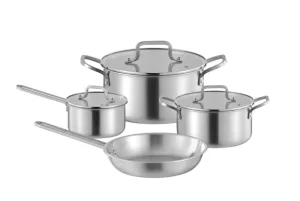
 Weihua Hardware