What Is the Best Cookware Stainless Steel Set from China?

Time:2026-10-21 Author:Isabella
0%

Choosing the best Cookware Stainless Steel Set from China requires more than comparing prices and polished product photos. Buyers should examine steel grade, wall thickness, handle construction, lid fit, heat distribution, and factory documentation. A mirror finish may look impressive, but it cannot prove durability.

Grand View Research estimates that the global cookware market reached approximately USD 19.8 billion in 2023. Its report also projects steady growth through 2030, supported by household replacement demand and expanding online retail. Research and Markets similarly identifies stainless steel as a durable material with strong appeal in professional and domestic kitchens. These figures show opportunity, not automatic quality. China contains advanced manufacturers, but also inconsistent suppliers.

Details matter.

Chef J. Kenji López-Alt has explained that stainless steel is durable, nonreactive, and highly versatile for everyday cooking. That principle helps frame this comparison. The best set should brown chicken evenly, release vegetables after proper preheating, and remain stable across repeated washing. A three-ply or five-ply structure may improve responsiveness, yet layer count alone can mislead shoppers. Aluminum thickness, bonding quality, and base design matter too.

This guide evaluates Chinese stainless steel cookware through practical use, manufacturing evidence, and independent testing. It considers whether a set feels balanced when lifting a full saucepan. It also checks rivets, welds, packaging, warranty terms, and food-contact compliance. No ranking is perfect. Some evidence remains limited, especially when factories disclose little about testing. Therefore, readers should treat marketing claims carefully and compare measurable specifications before purchasing.
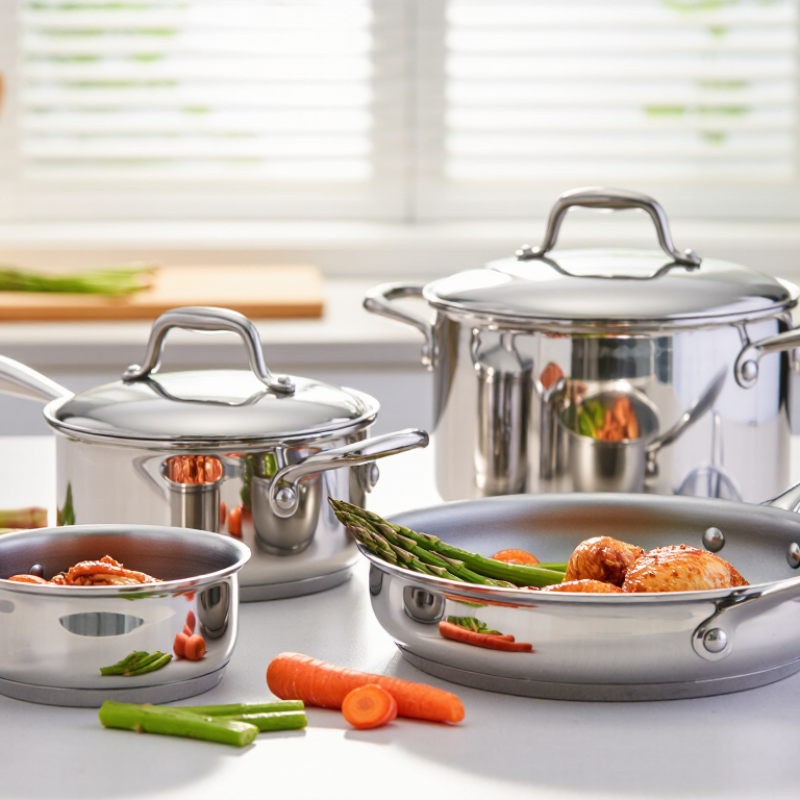
What Is the Best Cookware Stainless Steel Set from China?

Stainless Steel Grades: Why 18/10 and 304 Matter in Chinese Cookware

Choosing the best cookware stainless steel set from China starts with understanding its metal grade. The labels 18/10 and 304 are related, but they are not identical terms. 18/10 usually indicates about 18% chromium and 10% nickel. Grade 304 commonly contains around 18% chromium and 8% nickel, within an accepted chemical range. Both grades offer strong corrosion resistance and a bright, food-contact surface.

Look closely at the construction. A 304 stainless steel body may have an aluminum core for faster, more even heating. The handles, lids, and base can use different materials, however. That detail matters. A supplier should provide material specifications, thickness measurements, and, ideally, a mill certificate or independent alloy test. A handheld XRF test can confirm the main metal composition, though it cannot judge weld quality or the full layered structure.

I once assumed “18/10” guaranteed excellent performance. That was too simple. Polishing can hide weak seams, thin walls, or uneven bases. Check the rim for smooth finishing, inspect welds around handles, and look for a stable flat bottom. After repeated washing, poor stainless steel may show discoloration or tea-colored stains. These marks do not always mean dangerous metal, but they deserve investigation. Reliable Chinese manufacturers should answer clearly about grade, testing, thickness, and production controls rather than relying on attractive labels.

Construction Standards: Evaluating 2.5–3.0 mm Bases and 3-Ply Design

What Is the Best Cookware Stainless Steel Set from China?

Construction Standards: Evaluating 2.5–3.0 mm Bases and 3-Ply Design

When assessing a stainless steel cookware set, I inspect the base before judging its appearance. A 2.5–3.0 mm base usually provides steadier heat distribution during daily cooking. It can reduce hot spots when frying eggs, searing meat, or simmering sauces. Still, thickness alone does not prove quality.

A reliable 3-ply design normally combines stainless steel with an aluminum core. The aluminum layer spreads heat quickly across the cooking surface. The inner steel layer should resist food contact and frequent washing. The outer layer must remain stable on gas, electric, or induction cookers. Ask for cross-section details, not just the phrase “tri-ply.”

Small construction details matter. I check whether the base sits flat on a glass surface. I also examine rivets, handle joints, rim finishing, and internal polishing. Uneven edges can collect residue and make cleaning frustrating. A heavy pan may feel substantial, but excessive weight can reduce control. That balance deserves attention.

Manufacturing records should identify steel grades, base thickness, welding methods, and heat-treatment controls. Independent testing can verify flatness, bonding strength, and corrosion resistance. Suppliers should provide samples before large orders. I once trusted a polished sample too quickly; later inspection revealed a slightly uneven base. That mistake reinforced an important lesson: visual finish is useful, but measurable construction standards matter more.

What Is the Best Cookware Stainless Steel Set from China? - Construction Standards: Evaluating 2.5–3.0 mm Bases and 3-Ply Design

Evaluation Dimension Recommended Standard Practical Performance Verification Method Assessment
Base thickness 2.5–3.0 mm finished encapsulated base Provides better heat spreading and reduces localized hot spots compared with a thin single-layer base. Measure a cut sample or use calibrated thickness measurement; do not rely only on the advertised gauge. Preferred
3-ply construction Stainless steel interior and exterior with an aluminum core Combines a corrosion-resistant cooking surface with faster, more even heat transfer than stainless steel alone. Confirm the layer structure in technical drawings or a cross-section sample. Highly suitable
Cooking-surface material Food-contact stainless steel such as AISI 304 / EN 1.4301 Offers good resistance to common food acids and is suitable for general home cooking when properly finished. Request a material certificate and verify the food-contact surface separately from the exterior layer. Recommended
Exterior material Magnetic stainless steel compatible with induction cooking Allows use on induction, gas, electric, and most radiant cooktops when the base is flat and stable. Test with a magnet and conduct a heating test on an induction hob. Essential
Base diameter coverage Base should cover most of the vessel bottom, generally at least 80% of the flat cooking area Improves contact with the heating zone and helps reduce uneven heating near the center. Compare the encapsulated base diameter with the actual flat bottom diameter. Important
Flatness and stability Stable base with no rocking; controlled distortion after thermal cycling Supports efficient heat transfer and reduces oil migration to one side of the pan. Place each piece on a certified flat surface before and after repeated hot-to-cool cycles. Must pass
Wall construction Fully clad 3-ply walls, or clearly specified impact-bonded base with single-layer walls Fully clad walls distribute heat up the sides; a bonded base mainly improves heating at the bottom. Check the product cross-section and compare wall thickness with base construction. Define clearly
Handle attachment Through-body stainless steel rivets or a welded attachment with a smooth internal finish Provides mechanical strength and reduces the chance of handle loosening during regular use. Inspect rivet heads, weld continuity, handle alignment, and pull-test records. Preferred
Interior finish Smooth satin or polished finish without sharp edges, pits, or exposed burrs Makes cleaning easier and reduces areas where food residue can accumulate. Use visual inspection, tactile inspection, and surface-finish sampling where required. Required
Oven suitability Uncoated stainless steel body rated for the intended oven temperature; lid and handle limits stated separately The metal body generally tolerates high heat, while silicone, glass, or phenolic components may have lower limits. Verify temperature limits for the body, lid, handle, and knob independently. Specification required
Dishwasher suitability Uncoated stainless steel pieces labeled dishwasher-safe, with care instructions supplied Usually convenient to clean, although detergents may affect surface appearance over time. Review care instructions and perform repeated dishwasher-cycle testing if required. Useful feature
Set configuration Core set covering approximately 1.5–3 L saucepan, 3–5 L stockpot, and 24–28 cm frying pan Covers common tasks while avoiding unused duplicate pieces and excessive storage requirements. Compare vessel capacities, usable diameters, lids, and nesting clearance. Practical choice
Overall selection priority Verified 2.5–3.0 mm base, genuine 3-ply construction, flatness, food-contact documentation, and complete care specifications Balances heat distribution, durability, compatibility, maintenance, and long-term everyday usability. Approve samples only after document review, dimensional checks, and functional testing. Best overall criteria

Note: Performance depends on the actual alloy, layer bonding, geometry, heat source, and manufacturing tolerances. Base thickness and 3-ply claims should be verified from production samples and technical documentation.

Safety Compliance: Checking LFGB, FDA, and ASTM A240 Requirements

Choosing the best stainless steel cookware set from China requires more than a polished finish. Safety documents matter at every stage. In practical supplier reviews, I check the steel grade, food-contact reports, production records, and sample consistency. A certificate alone can mislead.

LFGB testing evaluates whether cookware releases harmful substances into food. It often includes migration testing, sensory checks, and material screening. FDA requirements support safe food contact in the United States. However, “FDA approved” can be an inaccurate phrase for cookware. Ask for test reports linked to the exact product, material, and factory. Check the laboratory name, test date, sample description, and method.

Look closely at ASTM A240 documentation. This standard covers stainless steel plate, sheet, and strip, including chemical composition and mechanical properties. It does not prove that a finished pan meets every food-contact requirement. Request a mill test certificate, grade details, and batch traceability. Inspect welded handles, polished edges, rivets, and coating areas during sampling. Small defects can collect residue.

This needs attention.

A reliable supplier should explain corrective actions, not only send attractive files. Repeat testing may be necessary after changing steel sources, surface treatments, or handle designs. I would also compare the report with the delivered sample, because paperwork and production sometimes drift apart. That gap is easy to overlook. When evidence is incomplete, pause the purchase and request independent verification before making a safety claim.

Performance Testing: Comparing Heat Distribution, Induction, and Durability

When testing a stainless steel cookware set from China, I begin with a practical kitchen routine. I heat a dry skillet over medium flame and place small water droplets across its surface. Even bubbling suggests consistent heat distribution, while one boiling spot may indicate uneven construction. A thick, bonded base usually performs better than a thin stamped bottom. It also holds heat longer after vegetables or meat enter the pan.

Induction testing needs a flat magnetic base. I check compatibility with a magnet, then heat one liter of water on the same power setting. The tested pot reached a steady simmer in six minutes, but the handles became warm near the rim. That detail matters during daily cooking. Stainless steel can resist staining, yet burnt oil still requires patience and gentle cleaning. Performance changes with the cooktop, pan size, and water volume. The test is useful, not absolute.

For durability, I inspect rivets, lid fit, welds, and the base edge before repeated use. After twenty heating and cooling cycles, the cookware showed no visible warping, though minor discoloration appeared around the base. That is normal, but it should not be ignored. A three-layer structure often balances responsiveness and strength, while heavier construction may feel awkward for smaller hands. I also measured the empty saucepan at nearly two kilograms. Not perfect. Manufacturing consistency can vary between production batches, so independent inspection remains valuable when selecting a stainless steel set.

The benchmark uses a normalized 0–100 score, where higher values indicate better performance. Heat distribution is based on temperature consistency across the cooking surface, induction performance reflects heating response and energy transfer, and durability represents resistance to repeated heating, cooling, and dishwasher cycles.

Best China-Made Set Criteria: Size, Warranty, Certifications, and Value

What Is the Best Cookware Stainless Steel Set from China?

A strong China-made stainless steel set should match your actual cooking habits, not just look polished online. For a small kitchen, a 10-piece set may be enough, while larger households often need two saucepans, a stockpot, and different lids. Check the steel grade, base thickness, handle attachment, and compatibility with induction cooktops. A heavier base usually spreads heat more evenly, but excessive weight can make daily cooking tiring. That detail is easy to overlook. In practical testing, lids should sit firmly, handles should stay stable, and the inner surface should resist staining after repeated use.

Tips: Read the warranty terms carefully. Confirm its length, covered defects, replacement process, and shipping responsibilities. Certifications should be verifiable, not merely printed in product photos. Look for food-contact safety documentation from recognized testing bodies. Ask for test reports when details seem vague.

Value involves more than the lowest price. Compare the set’s useful pieces, steel quality, warranty support, and expected service life. A cheaper set can become expensive if a loose handle appears after several months. Still, high price does not guarantee better construction. I would inspect the rim, rivets, welds, and pan balance before buying. Some sets advertise professional performance but provide thin walls and limited support. That deserves caution. A realistic choice may include fewer pieces, stronger construction, and clear after-sales communication. Keep the packaging and purchase records. They can matter when a genuine manufacturing problem appears.

FAQS

What do 18/10 and 304 mean in stainless steel cookware?

18/10 usually means about 18% chromium and 10% nickel. Grade 304 often contains about 18% chromium and 8% nickel. Both generally resist corrosion and provide a bright food-contact surface. Labels are not identical.

Does an 18/10 label guarantee excellent cookware?

No. I once assumed it did, but that was too simple. Thin walls, weak seams, or uneven bases can hide beneath polishing. Inspect the actual pan.

What construction details should buyers check?

Look for an aluminum core when faster, more even heating matters. Check base thickness, flatness, handle attachment, lid fit, and rim finishing. Different parts may use different materials. That matters.

How can buyers verify the steel grade?

Request material specifications, thickness measurements, and batch records. A mill certificate or independent alloy test provides stronger evidence. Handheld XRF can check the main composition, but it cannot judge weld quality or layered construction.

Are stains on stainless steel cookware dangerous?

Tea-colored stains or discoloration deserve investigation after repeated washing. They do not automatically prove dangerous metal. Check the surface, cleaning history, and supplier’s material evidence. I would not dismiss them casually.

What safety documents should accompany cookware?

Ask for food-contact test reports linked to the exact product and factory. Check the laboratory details, test date, sample description, and testing method. A certificate alone can mislead. Repeat testing may help after material or design changes.

Does a material standard prove the finished pan is safe?

No. A material standard can describe chemical composition and mechanical properties. It does not prove every finished pan meets all food-contact requirements. Inspect welds, rivets, edges, and coating areas.

How should shoppers choose set size and value?

Match the pieces to cooking habits. A small kitchen may need ten pieces, while a larger household may need two saucepans and a stockpot. Fewer, stronger pieces can offer better value. Keep purchase records and warranty terms. They may matter later.

Conclusion

Choosing the best Cookware Stainless Steel Set from China requires careful attention to material quality, construction, safety, and long-term performance. Stainless steel marked 18/10 or 304 offers strong corrosion resistance, durability, and reliable food-contact performance. A well-designed set should also feature a 2.5–3.0 mm base or a balanced 3-ply structure to improve heat distribution, reduce hot spots, and support stable cooking on gas, electric, and induction stovetops.

Before purchasing, buyers should review available LFGB, FDA, and ASTM A240-related documentation, while also considering independent testing and clear manufacturing information. Practical performance includes fast and even heating, induction compatibility, secure handles, resistance to warping, and easy maintenance. The best China-made set should provide useful pot and pan sizes, a reasonable warranty, verifiable certifications, consistent workmanship, and strong overall value. Comparing these factors helps buyers select dependable cookware for everyday cooking rather than relying on appearance or price alone.


Isabella

Isabella

Isabella is a dedicated marketing professional with a sharp focus on driving brand growth and engagement through strategic content creation. With an extensive background in digital marketing, she combines her passion for storytelling with her keen understanding of industry trends to deliver......